


The product management role is having an identity crisis right now. And to be honest, it’s about time.
I’ve been watching this happen for over a decade. When I started as a PM, you had to know how to code - or at least be able to fake it convincingly enough. You had to design things in Photoshop or later Sketch. You had to figure out go-to-market on your own because there simply weren’t enough people in the company who knew how to do this stuff.
Then somewhere along the way, the role got complicated. It became specialized, professionalized. And in many companies, it became completely hollow - all theater, no substance.
Now AI is forcing things to change, and a lot of PMs aren’t going to like it.
How the PM Role Evolved (And Why It’s Evolving Back)
Let’s talk about what “product manager” actually means in 2026. The role has gone through an interesting evolution:
The Original PM was essentially the founder. You did everything because you had to - sales, marketing, design, code, strategy, all of it. Every startup still has this person, usually the CEO or CTO. Thirteen years ago when I started, this was the norm even in larger companies. You couldn’t just write a spec and throw it over the wall to someone else. You had to roll up your sleeves and make things happen.
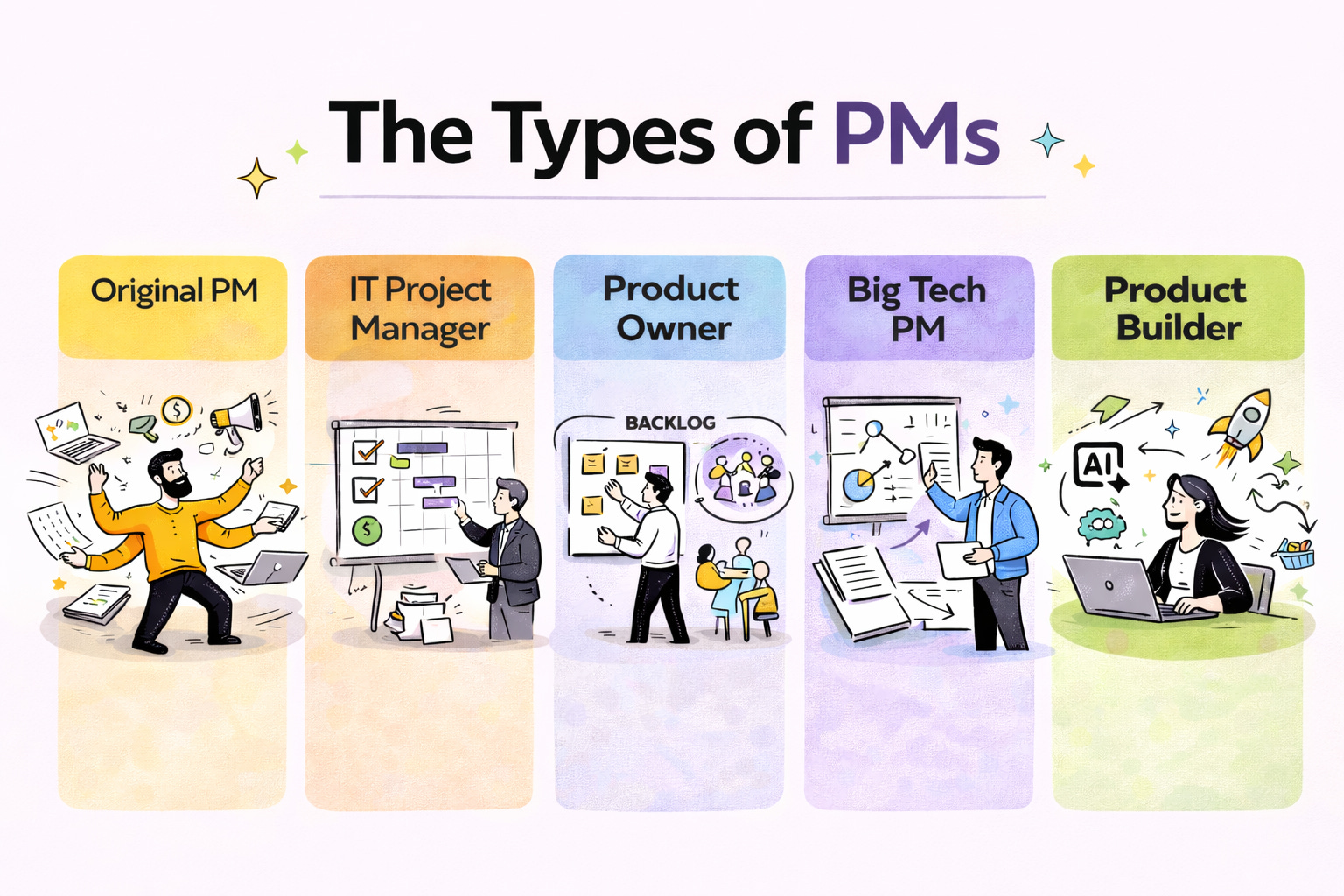
Then as companies grew and products became more complex, the role specialized. The generalist PM split into different types:
The IT Project Manager emerged to manage projects, not products. They’re focused on scope, timeline, and budget, but the strategy comes from business stakeholders or external clients. They’re executing someone else’s vision, keeping the trains running on time.
The Product Owner showed up with Agile methodologies. They’re backlog managers who run all the ceremonies - standups, retros, planning sessions - but they don’t actually own the strategic direction of what they’re building. Marty Cagan calls this “product management theater,” and that’s exactly what it is. All the motions, zero substance.
The Big Tech PM is the one who actually owns strategy and direction. This is the “real” PM role that everyone aspires to. But here’s the thing - they’re pure strategists. They write documentation, align stakeholders, do research, pitch ideas. Then they hand everything off to specialists. Designers figure out how it should look, engineers figure out how it should work, marketers figure out how to launch it. They’re conducting the orchestra, not playing the instruments.
This specialization made sense when coding was hard and coordination was necessary. But now AI is changing the equation.
The Product Builder is the new type that’s showing up now - and it’s basically the original PM coming back, but with AI superpowers. They have a core skill (engineering, design, or PM) but they’ve picked up 2-3 adjacent skills that let them ship end-to-end without handoffs. An engineer who learned design and product thinking. A designer who can code and run growth experiments. A PM who can build prototypes and launch them.
They use AI tools to level up in areas outside their expertise, but they know enough to judge what good looks like. The key is they combine both: the strategic judgment to know what to build AND the tactical ability to build it themselves.
From Assembly Line to Rapid Validation
The old way of building products looked like an assembly line. UX Research would study users, hand off insights to Design. Design would create mockups, hand off to Product to write specs. Product would hand off to Engineering to build. Engineering would hand off to QA to test. Then maybe you’d iterate.
Each specialist did their part. Each handoff took time. The whole cycle could take months.
This made sense when coordination was cheap and building was expensive. You needed all those specialists because each domain - research, design, engineering, testing - required deep expertise that couldn’t coexist in one person.
Now you can build a working prototype in the time it used to take to finish the research phase. With tools like Lovable, Replit, and Cursor, one person can go from idea to functional software in hours. Test it with real users. Get feedback. Iterate. All before the traditional assembly line would have moved from UX Research to Design.
When you finally need to build the production version, you show the AI your validated prototype and user feedback. It figures out what to build from there.
I see this transition happening in real-time. A Principal Designer I talked to, isn’t waiting for the assembly line anymore. He’s not just designing interfaces—he’s vibe coding working prototypes. Electron-based desktop apps. Full features. He validates ideas in days, then hands engineers a working prototype instead of static mockups.
He’s one of the most productive persons on his Agile team. Why? Because unlike in the old world, when everyone was waiting for the previous specialist to finish their work, he is able to prototype, test with users and ship on his own. The bottleneck isn’t his speed anymore—it’s everyone else’s handoffs.
That’s the future showing up unevenly distributed. He is a Product Builder surrounded by specialists still playing their roles. And the specialists have to be moving slower because of the handoffs.
But here’s the trap: when building becomes this cheap, companies face a new problem. Abundance.
In an economy where production costs approach zero, everyone can build everything. More prototypes. More apps. More products. The constraint isn’t “can we build this?” anymore. It’s “should we build this?”
Amazon saw this coming. They built Cairo, a development environment that forces you to write testable specifications before generating any code. When Amazon - a company that profits from speed - decides the most valuable thing is to slow you down and make you define what you want clearly, that tells you everything.
The bottleneck moved from execution speed to clarity of intent. From “how do we build?” to “what deserves to be built?”
From Two Pizza Boxes to One
You’ve probably heard the old Agile saying - a perfect team is small enough to be fed with two pizza boxes. That traditionally meant 4-6 people: a PM, a designer, 2-3 engineers, maybe a researcher.
But with product builders who can design, code, and ship autonomously, you’re looking at 2-3 people doing the same amount of work. We’re moving into a one-pizza-box reality.
What I’m seeing in practice is that when everyone on a team is a full-stack product builder, most people work solo on their own pieces within small teams. Each person owns their area end-to-end. There are fewer dependencies, less passing the brick around between specialists, less waiting on other people to unblock you.
This completely changes team dynamics.
Dailies stop being about alignment and blocker detection. Because when people aren’t dependent on each other, there simply aren’t that many blockers to discuss. Instead, these meetings become more like social coffee breaks - early morning check-ins where people catch up.
And you know what? That’s actually fine. People need social connection at work. But let’s not pretend it’s still a coordination meeting.
But if teams are shrinking and everyone works solo on their own pieces... what happens to all the organizational structures we built around coordinating specialists?
Three Things Nobody’s Talking About
The PM Career Ladder Collapses
Most companies have a nice, clean progression: APM → PM → Senior PM → Principal PM → Group PM → VP of Product. It’s linear and predictable.
But if Product Builders are working solo and owning things end-to-end... what exactly are you promoting them into?
You can’t really “manage” 2-3 autonomous builders the same way you managed a 6-person team of specialists. There’s no coordination overhead to oversee anymore. No handoffs to optimize. No ceremonies to facilitate.
The economics prove this. Cursor generates $16 million per employee. Midjourney hit $200 million in revenue with 11 people. When one person with the right skills and agent infrastructure can produce what a 20-person team used to build, they capture most of the value that used to be distributed across that team. The middle management layer that used to coordinate all those specialists simply isn’t needed anymore.
The career ladder collapses into something much simpler: Builder → Senior Builder → Founder or Executive. The Group PM role coordinating other PMs stops making sense.
So if you’re a Senior PM today and you’re banking on that Group PM promotion in a couple years, you might want to start rethinking your career path.
Hiring Becomes Completely Different
How do you even interview for this new type of role?
