


In May, Polish tech had its champagne moment. Viktor.com (founded by ex-Meta engineers Fryderyk Wiatrowski and Peter Albert) raised $75 million from Accel, the largest Series A in Polish tech history. Their product is a digital AI employee that lives in Slack and Teams, remembers everything, and hands you finished work. Ten weeks after launch it was earning $15 million a year.
Five weeks after the round, Anthropic shipped Claude Tag: an always-on Claude that lives in Slack, remembers everything, and hands you finished work. The same product, as a feature, available overnight to every Anthropic enterprise customer.
Anthropic wasn’t copying anyone. It had been using Claude Tag internally before the launch, and 65% of its product team’s code now comes from it. Viktor’s founders were building, without knowing it, a feature that was already on the lab’s roadmap.
That collision is why your AI product idea probably doesn’t matter.
Intelligence is becoming table stakes
The old playbook for AI founders was simple: pick a use case, wrap a frontier model, move fast. It worked while the frontier was scarce.
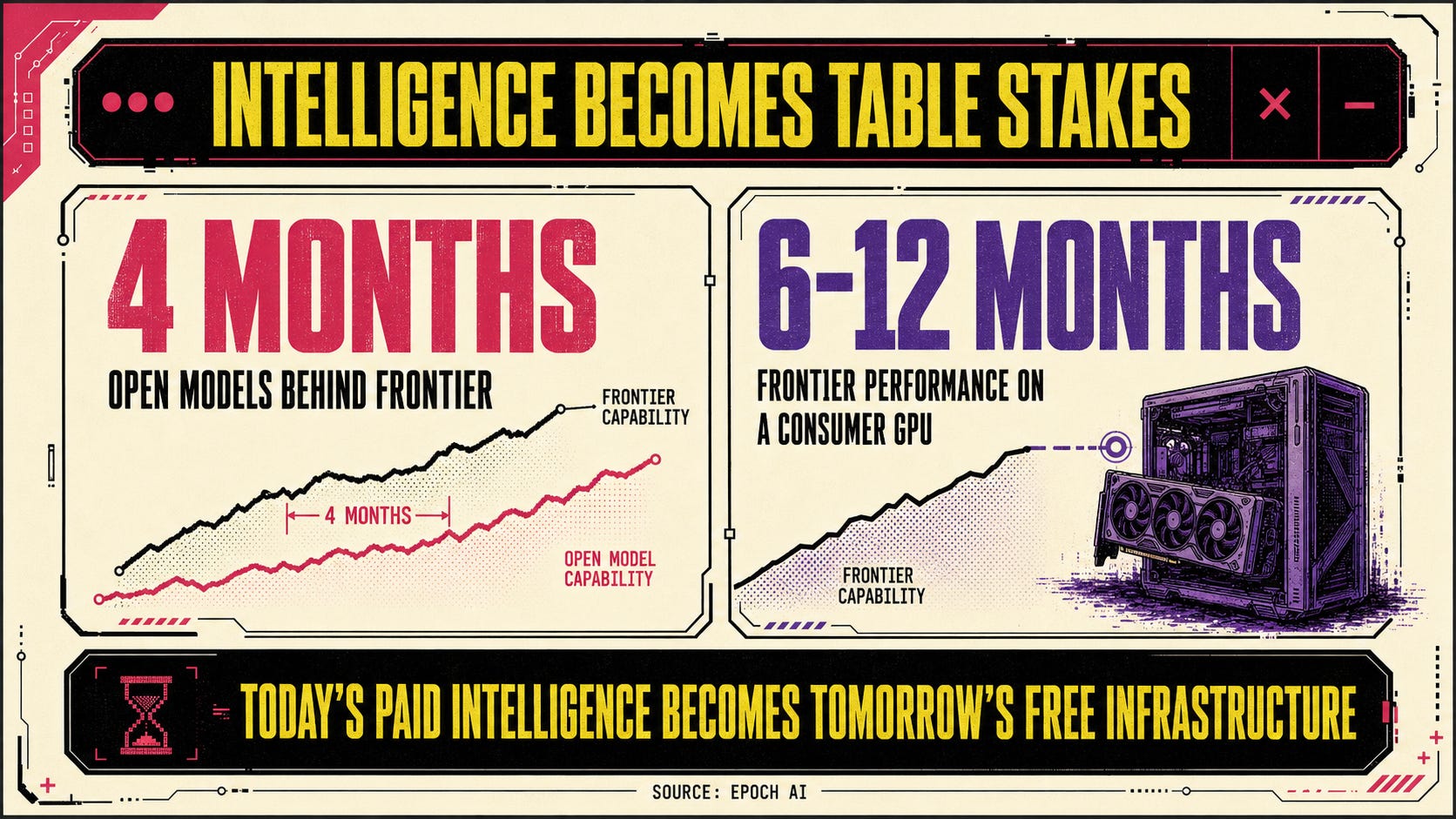
It isn’t anymore. Epoch AI tracks the gap: the best free, open models are about four months behind the frontier, and models that run on a regular gaming PC are six to twelve months behind. The intelligence you pay OpenAI for today will run free on a $2,500 gaming rig about a year from now.
Meanwhile the top itself has converged. Last week Grok 4.5, GPT-5.6 and Meta’s Muse Spark 1.1 all shipped within 48 hours, each claiming its own sliver of state of the art.
When everyone has superb intelligence, intelligence stops being a business. Even OpenAI’s GPT-5.6 pitch wasn’t “smarter” but “more useful work out of every token.” Usefulness means product, and the labs are coming for it.
The kill zone
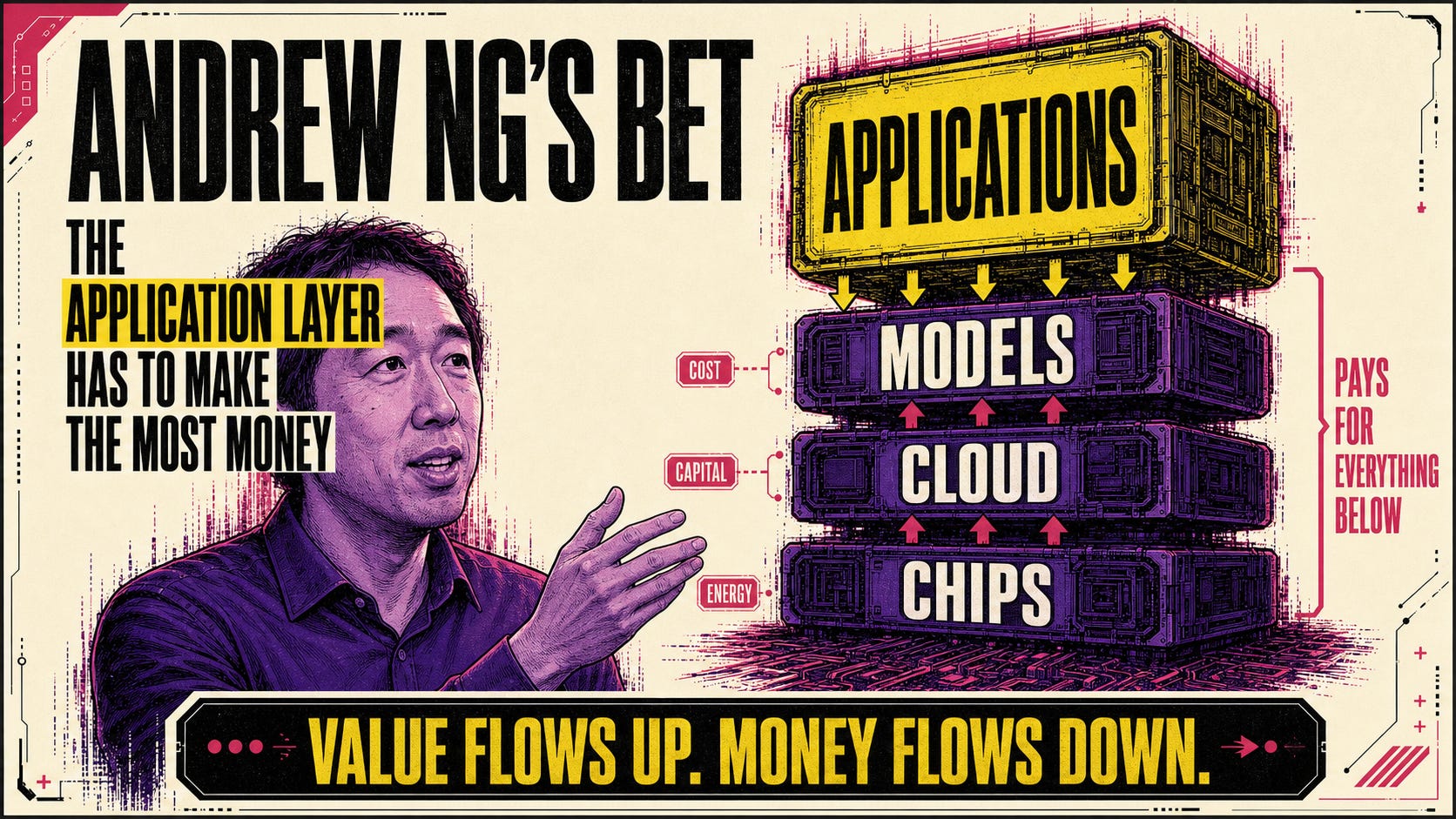
Andrew Ng has said it for years: in the AI stack (chips, cloud, models, applications) the application layer has to make the most money, because it pays for everything underneath. The labs read the same map. So they moved up.
Anthropic shipped Claude Code, then Cowork, then Tag. OpenAI shipped ChatGPT Work. Google bundles Gemini into everything with a login. And SpaceXAI skipped the building part: on June 16 it bought Anysphere, the company behind Cursor, for $60 billion in stock, the largest startup acquisition ever.
Why would Cursor sell? It earned about $4 billion a year, more than any AI app in history. But every Claude token it served, it bought from Anthropic at full API price, while Anthropic sold Claude Code, a direct competitor, powered by the same model at cost. Within a year Cursor’s share of AI coding fell from 41% to 26%; Anthropic’s grew toward half the market. Cursor did everything right and still needed a $60 billion lifeboat, because its supplier had become its competitor.
That’s the squeeze from above. There’s another from below. Wispr Flow sells dictation for $15 a month; free tools running open models on your own laptop now do the same job at 95-97% accuracy. Nobody bought or copied Wispr Flow. The free floor simply rose to meet it.
With labs above you and free models below you, the thin layer in between is the kill zone.
The apocalypse that wasn’t
In February the market briefly panicked about all software. When investors saw what Claude Cowork’s agents could do, software stocks lost roughly $300 billion in a single day, the “SaaSpocalypse.” By April the prices had mostly recovered.
The panic taught a useful lesson. The software that died was the simple kind, $29-a-month tools whose one trick a general model now does for free. The software that survived was the deep kind: systems like Epic (hospital records) or IQVIA (clinical trials) that hold years of data, integrations and regulatory approvals. Nobody canceled Jira and asked an agent to rebuild it, because ripping out twenty years of process is harder than paying for it.
The labs won’t build a hospital records system. Neither will your customers. That’s the gap where durable businesses live.
What to do instead
Go deep in one industry, and know what you’re really building. Harvey, the legal AI company, is worth $11 billion and serves most of America’s biggest law firms, but its moat isn’t data. The legal data belongs to LexisNexis and Thomson Reuters, and Harvey isn’t even allowed to train on it. What Harvey owns is everything around the data: it sits inside Word, passes the strictest compliance reviews, and knows how law firms actually work. In most industries someone already owns the data; the workflow, the certifications and the relationships are still up for grabs.
Or sell a service instead of a product. Software is a $1 trillion market; services are $16 trillion. General Catalyst has spent $1.5 billion buying accounting firms and call centers and rebuilding them around AI. One of those bets reached $100 million of yearly profit in under two years. The same play works alone: one consultant with AI can serve what used to take a team of ten. And a service has a defense software never will: a human who answers for the result.
Or sell to the labs instead of competing with them. They rent their data centers (Anthropic runs Claude on CoreWeave’s machines) and they buy the tools they work with. Neptune.ai, a Warsaw platform researchers use to monitor model training, counted OpenAI as a customer for a year; in December OpenAI bought the whole company for up to $400 million. The labs also can’t build neutral tools. Most big companies run several models side by side, and the scoreboard comparing them can’t be made by one of the players. Just avoid anything a free plugin can replace: Pinecone, once a billion-dollar database startup, was undercut by a free Postgres extension.
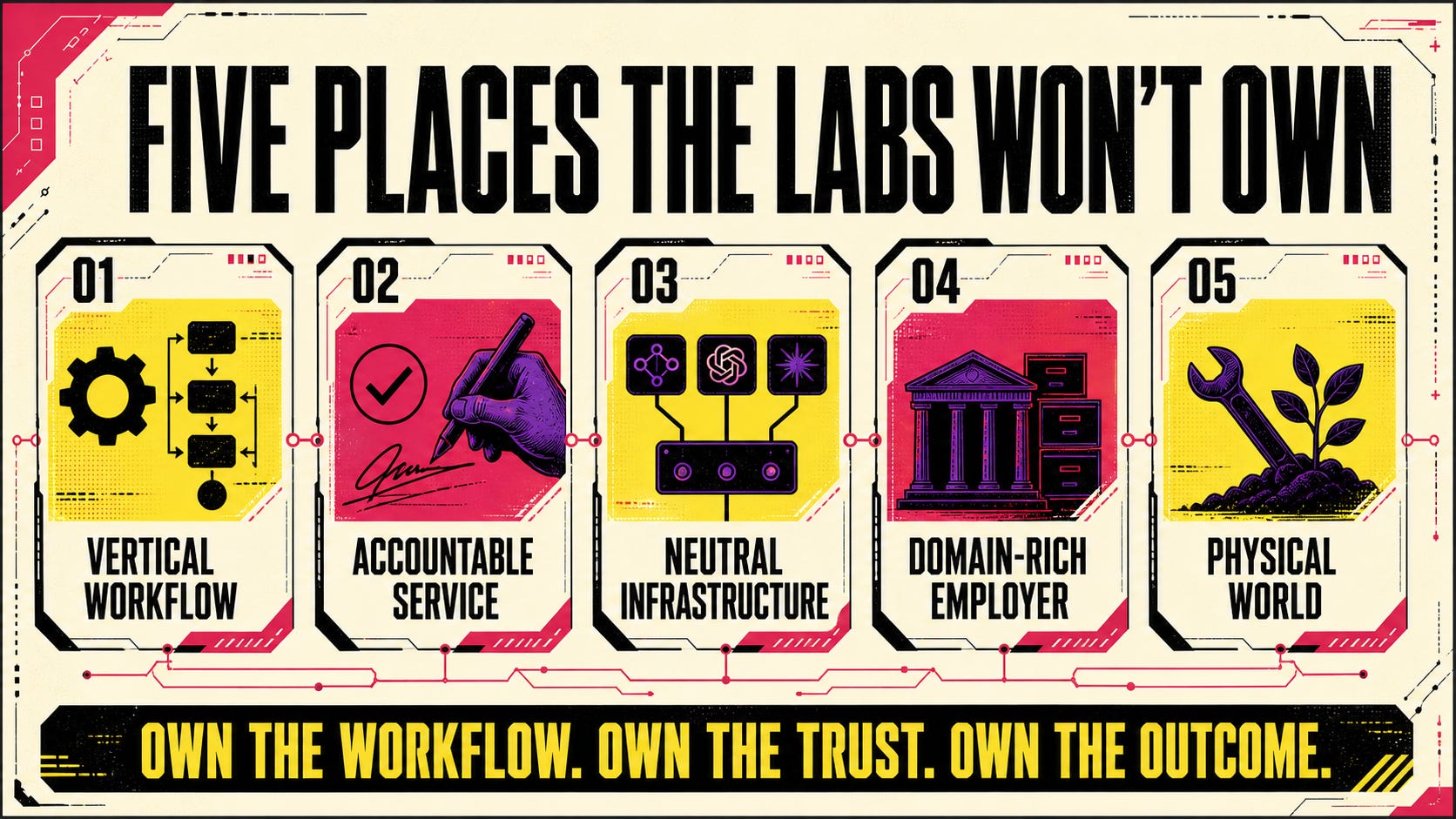
Or take these ideas to a job in tech, the right kind of tech. The safe employers are companies whose product carries domain depth no lab will rebuild: an Atlassian, whose tools hold twenty years of how software teams work, or a marketplace like Booking, whose moat is the list of hotels and the relationships behind it. People will keep traveling no matter how smart the models get. A job applying AI inside a company like that beats being employee number forty at the tenth wrapper startup, and pays in salary, not lottery tickets.
And the fifth path, half a joke: go physical. Land, food and fitness are businesses where AI helps but can never be the product. The story that AI researchers are quitting to buy farms turns out to be a myth, but what they actually buy is more telling. Sam Altman keeps “guns, gold, potassium iodide... and a big patch of land in Big Sur I can fly to.” Ilya Sutskever promised his team a bunker before AGI. Geoffrey Hinton tells young people to become plumbers. Draw your own conclusions.
But Cursor got $60 billion
Fair objection: if wrappers are doomed, why did one just sell for $60 billion?
Because selling was the only way out. Cursor couldn’t win a price war with its own supplier, so it sold at the top, the smartest move on the board. Perplexity waited too long: Apple considered buying it for about $14 billion and never made an offer, then ChatGPT and Google copied its search product, then its $400 million Snap deal collapsed. The company still grows, but its best exit is gone.
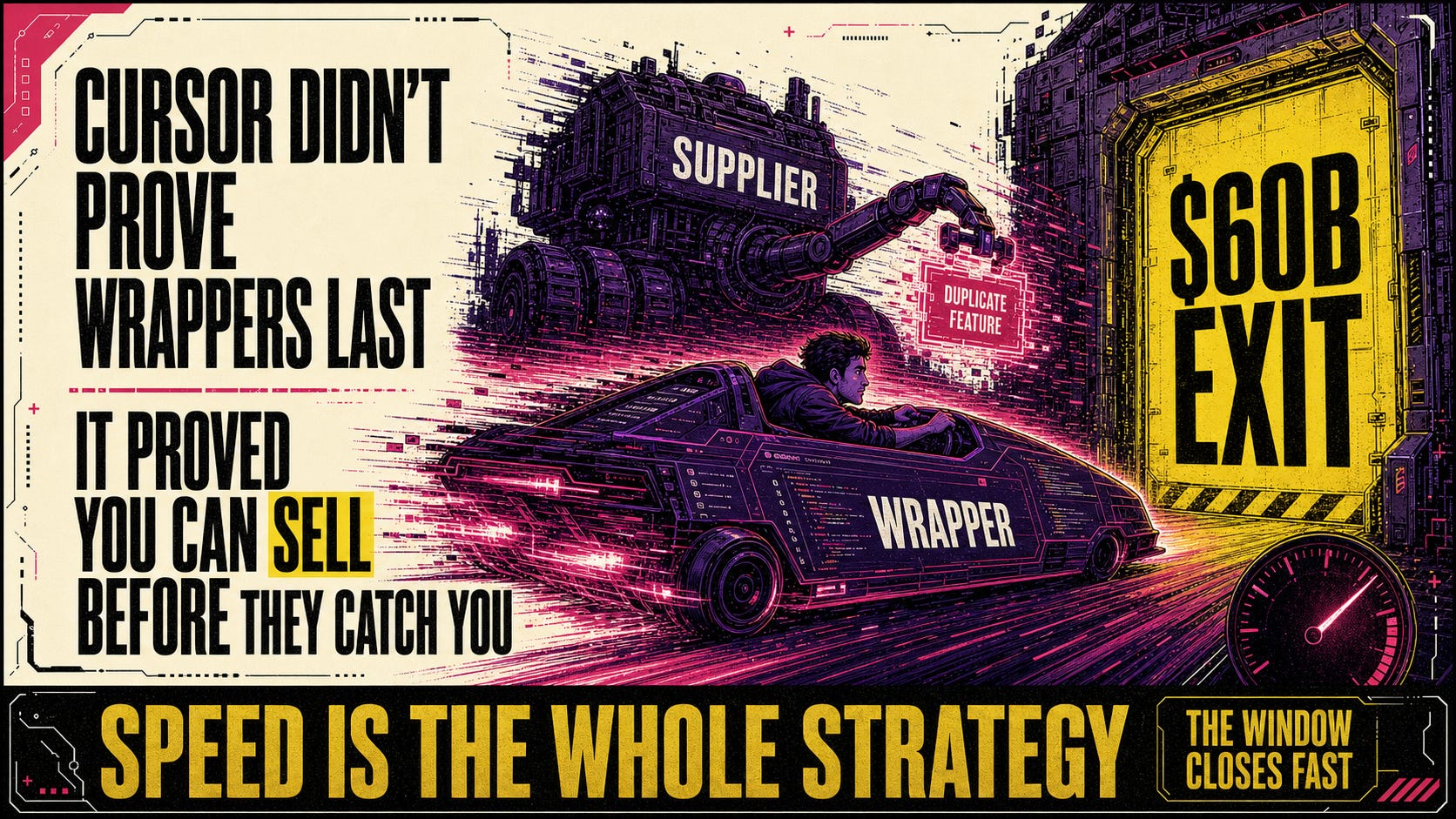
So yes, you can build a wrapper to sell it. Just be honest that this is the plan: a race to get acquired before you get copied. The window is real, but it closes fast.
What if you still want to build one?
Then build it with open eyes. There are two honest plans.
Plan one is the Cursor play: take the obvious idea, run faster than everyone, and sell before the labs catch up. It can work; it just made a few hundred people very rich. But it’s a sprint against a closing window, so speed is the whole strategy, and falling in love with the product is how you miss the exit.
Plan two is to build outside the labs’ path, and you can test your idea with three questions. Does the next model upgrade make your product better or pointless? If GPT-6 improves you, good; if it replaces you, stop now. Is your customer buying intelligence, or something around it: a certification, an integration into their industry’s systems, someone to blame when things fail? Intelligence belongs to the labs; everything around it can be yours. And could a lab honestly sell your product? Anthropic can’t sell the dashboard that says Grok is better, and nobody in San Francisco wants to face your industry’s regulator.
Whatever you pick, don’t repeat Cursor’s structural mistake: if one lab is both your supplier and your competitor, your margins belong to them. Route between models and keep the open ones as your fallback. They’re four months behind and free, which makes them your insurance as much as your competition.
The idea was never the moat
If your idea can be a feature of a frontier model, some lab is already building it; ask Viktor. If it can be a free tool, it will be one within months.
What lasts is what the labs can’t or won’t touch: an industry whose workflow and trust you own, a service with your name on the result, tools the labs need to stay neutral. Or, if you take Hinton seriously, a plumbing license.